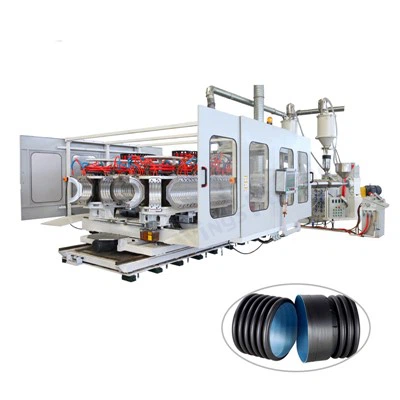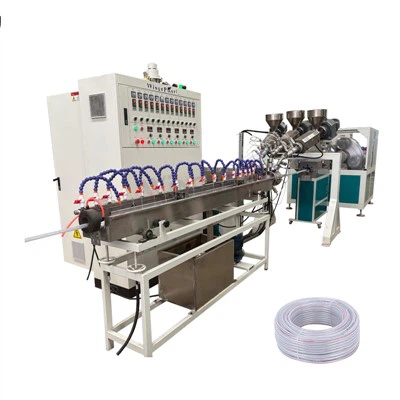
Plastic corrugated pipe machines are core equipment in plastic pipe production, primarily used for the continuous molding of water supply and drainage pipes. They melt plastic raw materials at high temperatures and extrude them through molds to form pipes with a corrugated structure. These machines feature high production efficiency, high pipe strength, and strong corrosion resistance, and are widely used in municipal engineering and building drainage systems.
Technical Principles and Core Structure: The core principle of plastic corrugated pipe machines is an integrated "melt-extrusion-molding" process. The equipment mainly consists of four parts: an extrusion system, a molding die, a cooling device, and a traction mechanism. The extrusion system heats plastic granules to a molten state through screw rotation; the molding die is designed with a corrugated structure, forming a corrugated profile as the molten plastic passes through the die; the cooling device quickly solidifies the pipe surface; and the traction mechanism controls the pipe's movement speed to ensure uniform corrugation.
Key technologies for stable molding: Achieving stable molding requires overcoming two major technical challenges: first, temperature control, which uses zoned heating and an intelligent temperature control system to ensure that the temperature fluctuation of the plastic during extrusion is less than ±2℃, preventing pipe cracking or deformation; second, speed matching, which uses variable frequency speed control technology to dynamically synchronize screw speed, traction speed, and cooling efficiency, ensuring that the corrugation spacing error is less than 0.5mm. In addition, some equipment is equipped with a front-and-back moving molding machine with adjustable center height to adapt to different mold specifications, improving production flexibility.